Healthcare changes. Standards evolve. Workloads increase. Habits develop. Sometimes documentation becomes rushed, incomplete, templated, or disconnected from the care actually provided. That does not automatically make someone careless or incompetent—it means the system and the professional may need support.

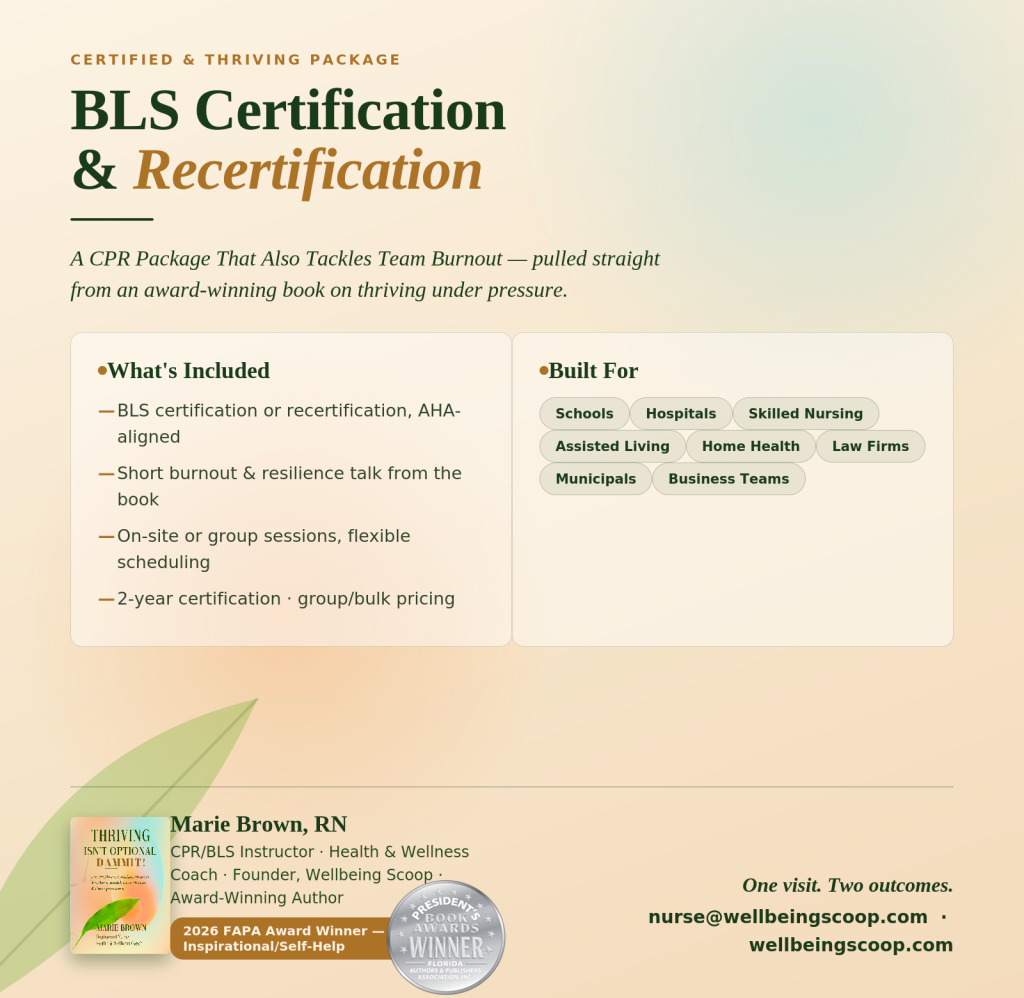
Instead of “just another CPR class,” I pair your team’s certification or recertification with a short speaking session pulled straight from the book, tackling burnout and resilience for the people holding everything together in high-stress roles.
BLS certification or recertification (AHA-aligned)
A short, engaging burnout & resilience talk from an award-winning book
On-site group sessions, flexible scheduling
2-year certification, group/bulk pricing available
Perfect for schools, hospitals, skilled nursing and assisted living facilities, home health agencies, law firms, municipalities, and business teams, anywhere your people are pouring out more than they are getting back.
You can be an accomplished, respected healthcare professional—and still need a confidential documentation refresher.
Healthcare changes. Standards evolve. Responsibilities grow. Workloads increase. Systems become more complicated. Over time, even experienced professionals can develop documentation habits that no longer reflect the quality of care they provide.
Notes become rushed. Templates replace individualized thinking, and highly capable professionals needs a safe place to refresh, strengthen, and update their skills. This is why this training exists.
- An experienced Quality Management RN who reviews patient complaints, adverse effects, quality of care issues.
- Health-insurance chart-review experience
- Quality-management insight-what gets flagged in your documentation
- Burnout awareness coaching-The DAMMIT! Effect Framework from her award-winning book
Before the Session:
- Confidential intake questionnaire-Identification of specialty, setting, and documentation concerns.
- Review of two appropriately de-identified sample notes
During The Session:
- Two hours of individualized virtual training
- Risk, assessment, reasoning, intervention, response and follow up
- Burnout awareness strategies for clearer documentation
- Before-and-after note transformation
After The Session:
- Clinical-reasoning checklist
- 30-minute follow-up within 30 days
- Limited clarification support for 14 days
You do not have to wait for an audit, complaint, denial, or legal inquiry to strengthen your documentation.
You are allowed to prepare before there is a crisis.
Educational and consultative training. No guarantee of audit, reimbursement, licensing, regulatory, or legal outcomes. Records must be appropriately de-identified before review.
You can be an accomplished, respected healthcare professional—and still need a confidential documentation refresher.
Healthcare changes. Standards evolve. Responsibilities grow. Workloads increase. Systems become more complicated. Over time, even experienced professionals can develop documentation habits that no longer reflect the quality of care they provide.
Notes become rushed. Templates replace individualized thinking. Important details remain in the clinician’s mind but never make it into the record. Assessments, decisions, patient communications, follow-up instructions, and the reasoning behind the plan may not be connected clearly enough for another person to understand.
That does not automatically mean someone is careless, unethical, or incompetent.
It may mean they are overwhelmed.
It may mean they were never properly taught.
It may mean they have spent years caring for everyone else while quietly trying to keep up.
And sometimes, it simply means that a highly capable professional needs a safe place to refresh, strengthen, and update their skills.
That is why this training exists.
RECORD Everything does not mean documenting every possible detail or filling the chart with unnecessary language.
It means documenting what matters.
- Record what is clinically relevant.
- Demonstrate what you assessed.
- Identify the information you considered.
- Explain the reasoning behind significant decisions.
- Document important patient communications and responses.
- Connect the assessment, intervention, plan, and follow-up.
- Create a record another qualified professional can understand.
- Ensure the documentation accurately reflects the care provided.
The goal is not longer documentation.
The goal is clearer, more complete, more defensible documentation.
Those individuals will not automatically know what the healthcare professional saw, considered, intended, explained, questioned, ruled out, or planned.
They will know what the documentation can reliably demonstrate.
Excellent care that is not clearly documented may become care that cannot be verified, defended, continued, or fully understood.
Documentation is not clerical punishment.
It is clinical communication.
It is professional memory.
It is continuity of care.
It is patient protection.
It is professional protection.
And sometimes, it is the only surviving witness to the care that occurred.
Documentation training is often presented as a list of deficiencies, rules, warnings, and consequences.
My approach is different.
As a Registered Nurse, health and wellness coach, author, and experienced clinical chart reviewer, I understand both sides of the documentation challenge:
- The record that must accurately demonstrate the care provided
- The human being working under the pressure behind that record
Documentation problems do not occur in isolation. They can be influenced by burnout, time pressure, cognitive overload, inefficient workflows, fragmented systems, competing responsibilities, knowledge gaps, fear, and professional shame.
Correcting the record without supporting the person behind it may produce temporary compliance—but it rarely produces lasting change.
My training is confidential, practical, burnout-aware, and judgment-free. It is designed to help healthcare professionals strengthen their documentation while preserving their dignity.
This is not remedial training. It is professional maintenance for people carrying serious responsibility.
A patient record may eventually be reviewed by people who were never present during the care.
Auditors. Insurers. Attorneys. Regulators. Licensing boards. Other clinicians. Patients. Families. Jurors.
Those individuals will not automatically know what the healthcare professional saw, considered, intended, explained, questioned, ruled out, or planned.
They will know what the documentation can reliably demonstrate.
Excellent care that is not clearly documented may become care that cannot be verified, defended, continued, or fully understood.
Documentation is not clerical punishment.
It is clinical communication.
It is professional memory.
It is continuity of care.
It is patient protection.
It is professional protection.
And sometimes, it is the only surviving witness to the care that occurred.
One-to-one, confidential documentation coaching for healthcare professionals who want individualized support without being judged, embarrassed, or exposed.
This service is especially valuable for experienced clinicians, advanced-practice professionals, executives, educators, consultants, and organizational leaders whose responsibilities may have grown faster than their opportunities for documentation training and feedback.
Depending on your needs, the intensive may address:
- Documentation habits and recurring vulnerabilities
- Clinical reasoning within the record
- Assessment-to-plan alignment
- Individualized versus templated documentation
- Patient communication and education
- Follow-up and continuity of care
- Contradictory, unclear, or unsupported statements
- Late entries, corrections, and addenda
- Audit and review readiness
- Building a sustainable documentation workflow
You do not have to wait for an audit, complaint, denial, or legal inquiry to strengthen your documentation.
You are allowed to prepare before there is a crisis.
An educational review designed to identify patterns that could prevent a patient record from communicating a clear, complete, and consistent clinical story.
The review may identify:
- Missing or incomplete documentation elements
- Gaps between the assessment and treatment plan
- Inconsistent or contradictory information
- Unsupported conclusions
- Unclear medical necessity
- Overreliance on templates or copied language
- Missing patient response or follow-up information
- Continuity-of-care concerns
- Documentation patterns that may create audit vulnerability
- Opportunities to improve clarity, efficiency, and defensibility
The purpose is not to shame the professional or search for reasons to assign blame.
The purpose is to help the record more accurately demonstrate the care, reasoning, communication, and follow-through that occurred.
Reviews must use appropriately authorized or properly de-identified records and follow applicable privacy and organizational requirements.
Documentation problems are not always individual performance problems.
Sometimes, they are system problems appearing in individual charts.
This training helps healthcare organizations examine how burnout, staffing demands, interruptions, workflow design, productivity expectations, fragmented technology, and cognitive overload affect documentation quality.
Training may include:
- Burnout and cognitive overload in clinical documentation
- Documentation risk created by inefficient workflows
- Common charting shortcuts and why they develop
- Creating psychologically safe opportunities for improvement
- Moving from punitive correction to sustainable accountability
- Recognizing organizational patterns across multiple records
- Strengthening documentation without encouraging unnecessary charting
- Supporting clinicians before problems become audit findings
- Building practical documentation standards teams can consistently follow
The objective is not performative compliance.
It is a healthier documentation culture that protects patients, professionals, and organizations.